
John Howie, a Scottish biographer, is best remembered for his work Biographia Scoticana, first published in 1775. Commonly referred to as The Scots Worthies, the book focuses on Christians, particularly Presbyterians, and their struggles with religious and civil authorities.
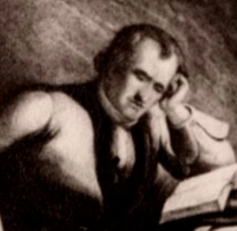
Howie was the 28th descendant in a direct family line where every male was named John. Despite being a simple, uneducated farmer working the same land his ancestors had for generations, he had a strong interest in writing. This passion led him to document the lives of Scotland’s martyrs and religious figures. His home, Lochgoin Farm, was a known haven for Covenanters and faced multiple searches by government soldiers. The farmhouse, rebuilt in the 18th century, bears the date 1187 on a lintel, marking when the family first settled there. The farm later became a small museum, preserving relics tied to its history. In 1896, a stone obelisk was erected nearby to honor Howie and his contributions. This monument is now located within Whitelee Wind Farm and is accessible via a path from the visitor center.
In 1779, Howie published A Collection of Lectures and Sermons by Covenanting Clergymen, which included his own introduction. The following year, he edited Faithful Contendings Display’d by Michael Shields, detailing the Church of Scotland‘s history from 1681 to 1691. Beyond these works, Howie wrote about topics such as the Lord’s Supper and patronage, and he provided commentary on other religious texts.
Howie also wrote a personal memoir, which offers moments of unintended humor. However, his writings reflect a sincere dedication to his faith, earning respect from readers. The Howie family of Lochgoin stands as a testament to the enduring religious traditions of an earlier era.
John Howie passed away on this day in 1793 at the age of 58.
Citations
- Bayne, Thomas Wilson (1891). “Howie, John“. In Lee, Sidney (ed.). Dictionary of National Biography. Vol. 28. London: Smith, Elder & Co.
- Couper, W. J. (1938). John Howie of Lochgoin and Fenwick. Edinburgh: Scottish Church History Society.
- Du Toit, Alexander (2004). “Howie, John”. Oxford Dictionary of National Biography (online ed.). Oxford University Press. doi:10.1093/ref:odnb/13992. (Subscription or UK public library membership required.)
- Fleming, David Hay (1903). “John Howie of Lochgoin”. The Princeton Theological Review. 7 (1). Philadelphia: MacCalla & Co. Inc: 1-28.
- Irving, Joseph (1881). The book of Scotsmen eminent for achievements in arms and arts, church and state, law, legislation, and literature, commerce, science, travel, and philanthropy. Paisley: A. Gardner.
 This article incorporates text from this source, which is in the public domain.
 - “Lochgoin Farmhouse And Monument To John Howie”. Canmore. 23 August 1956. Retrieved 27 November 2016.
- Shields & Guthrie 1780.
- Du Toit 2004.
- Howie, John (1870). Carslaw, W. H. (ed.). The Scots worthies. Edinburgh: Oliphant, Anderson, & Ferri
ALSO ON THIS DAY
1743 – George Whitefield and Welsh Calvinists Methodists form the first Methodist association at Wadford, Wales.
1874 – Kate Youngman and Mary Park opened Graham Seminary in Tokyo (named for Julia Graham, head of the Presbyterian’s foreign missionary office). They formed networks to evangelize among the Japanese and Youngman moved on to work with victims of leprosy.
1943 – After falling downstairs at his Tuskegee, Alabama, home, George Washington Carver died. He overcame the adversity of being born a slave to becoming a leading American educator and chemist. He was noted for his deep faith, humility, and lively Bible lessons.
1971 – The Jewish organization Yad Vashem recognizes the Reverend André Trocmé of the Reformed Church as Righteous among the Nations because of his efforts to rescue Jews in France during Nazi occupation. He and his wife Magda will be remembered with other Righteous Gentiles in the Episcopal Church calendar on July 19. In May 1984, Yad Vashem will recognize Magda for her role. André’s second cousin Daniel will also be recognized as Righteous among the Nations, having died in a concentration camp for his role protecting Jews.
 Rhemalogy