
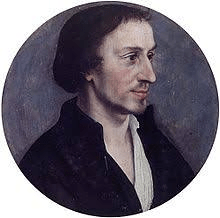
If Martin Luther was the heart of the Protestant Reformation, Philip Melanchthon was its head. Born in tiny Bretten, Germany on February 16, 1497 (at precisely 7:06 PM, if you’re keeping score), he would become Luther’s intellectual right hand and one of the most influential theologians of his time.
Born Philip Schwarzerd (“black earth” in German), he did what all the cool scholars did back then – he Latinized his name to Melanchthon. His childhood wasn’t exactly carefree. His tutor, Johann Unger, had a thing for corporal punishment, though Melanchthon later wrote about him with surprising affection: “He loved me as a son, and I him as a father.” Talk about Stockholm syndrome.
This kid was scary smart. While most twelve-year-olds were… well, being twelve-year-olds, Melanchthon was enrolling at the University of Heidelberg. He knocked out his Bachelor’s degree in two years flat, then headed to Tübingen for his Master’s. By twenty-one, he was teaching Greek at Wittenberg University – a job he landed thanks to his well-connected uncle, Johann Reuchlin. Sometimes it really is about who you know.
The timing couldn’t have been better. Luther had just nailed his famous 95 Theses to the church door, and Melanchthon found himself drawn to Luther’s radical idea that faith, not good works, was the ticket to salvation. The two became an unlikely but powerful duo – Luther the fiery revolutionary, Melanchthon the careful intellectual.
Melanchthon’s greatest hit was the Augsburg Confession, a masterclass in diplomatic theology that laid out Lutheran beliefs for Emperor Charles V. It’s still considered the definitive statement of Lutheran doctrine, with its core message that we’re saved by faith alone.
But being a moderate in revolutionary times is a tough gig. Other theologians attacked him from all sides, and even his buddy Luther lost it with him over disagreements about communion. Melanchthon tried to find middle ground, hoping to prevent the church from splintering. Spoiler alert: it didn’t work. By the end, he was so worn down by what he called the “frenzy of theologians” that he saw death as a welcome escape from all the religious drama.
His father’s deathbed advice to “follow God, fear Him, and do right” had shaped his entire life. Maybe too well – in a time of extremes, Melanchthon’s greatest sin might have been trying too hard to make everyone get along.
References
Article #35, “The truth might fare better at a lower temperature,” from In Context; The Stories Behind 70 Memorable Sayings in Church History is about Melanchthon.
Also On This Day
309 – Pamphilius of Caesarea is beheaded for his Christian faith. He had founded a library in Palestine and trained many pupils, including Eusebius, the first notable church historian.
1684 – Death of non-conformist pastor Francis Bampfield in Newgate Prison, having been held too long in a damp area. Once a Royalist, his loyalty to the crown had not protected him from the religious persecution of England’s King Charles II. Bampfield died outside the Church of England, a “non-conformist” committed to Seventh-Day Baptist views.
1844 – Koilas Chunder Mookerjee, a young Hindu convert to Christianity died from cholera in Calcutta. He suffered considerable persecution. Immediately after his baptism, he endeavored to evangelize fellow Indians.
1910 – Robert Ketcham, he listened as Harry S. Tillis preached in the Galeton Baptist Church. He asked Jesus to become his savior that day.
1911 – The Continent, a Presbyterian periodical, publishes the hymn, “Rise Up, O Men of God,” by William P. Merrill. The words had formed in his mind while he was crossing Lake Michigan on a ferry.
1977 – Murder of Archbishop Luwum for his Christian faith in Uganda under the brutal dictatorship of Idi Amin.
 Rhemalogy
Thank you for this analysis! This definitely brings greater depth to our faith when we read about the saints. God bless your week!
LikeLike
Amber you are so welcome! It is always a pleasure to hear from a dear friend. You have a blessed new week!
LikeLiked by 1 person