
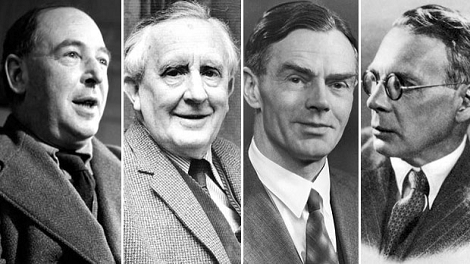
While scrolling through my This Day In Christian History came across a very interesting piece. A one-act dramatization of the infamous “Night Talk” refers to a significant conversation between C.S. Lewis, J.R.R. Tolkien, and Hugo Dyson on September 19, 1931, which profoundly influenced Lewis’s religious beliefs. During this late-night discussion, likely on Addison’s Walk at Oxford, they explored the nature of myths, particularly Christianity, and the possibility of a “true myth”. This interaction played a key role in Lewis’s eventual conversion to Christianity.. Around this time, he became (in his words) “the most dejected and reluctant convert in all England”.
The events of that night and the long conversation between Tolkien and Lewis are dramatized in a one-act play by Kevin O’Brien entitled “I Call You Friends – an Evening with Tolkien and Lewis”.
In a letter Lewis wrote to his friend Arthur Greeves about the talk that took place on that night …
In discussing poetry and books, they hit upon George MacDonald and William Morris. Lewis referred to Morris when the talk turned toward the topic of Longing, and how Longing is never completely satisfied in this life. Lewis wrote to Greeves …
“These hauntingly beautiful lands which somehow never satisfy,—this passion to escape from death plus the certainty that life owes all its charm to mortality—these push you on to the real thing because they fill you with desire and yet prove absolutely clearly that in Morris’s world that desire cannot be satisfied. … [Morris] is an unwilling witness to the truth. He shows you just how far you can go without knowing God, and that is far enough to force you . . . to go further.
Tolkien, of course, spoke of this Longing and of this Fulfilment as something hinted at, not only in the works of MacDonald and Morris, but in all myths and fairy stories, a transcendent joy that was “a joy beyond the walls of the world, poignant as grief”. This Longing, unable to be fulfilled fully in Middle Earth, is represented in The Lord of the Rings as the land beyond the sea. In The Return of the King, Tolkien has Legolas exclaim:
The Sea! Alas! I have not yet beheld it. But deep in the hearts of all my kindred lies the sea-longing, which it is perilous to stir. Alas! for the gulls. No peace shall I have again under beech or under elm.
And in the play, C. S. Lewis refers to an image he will later use in Pilgrim’s Regress.
But … this joy … I have only glimpsed it. As if through a window in a wood, seeing an island far away, an island that entices me, draws me out.
In the play we find these conversational insights are scattered amid moments of laughter, and take place at a kind of “symposium” of drinking and merriment. This was a night spent with friends.
THE YOUNG LEWIS: After all, the conversation was just getting interesting. Wasn’t it, Tollers?
THE OLD TOLKIEN: Yes … it was … but … I don’t remember exactly where we were.
LEWIS: Not yet forty and already in your dotage! Well, I’ll pick up the thread for you. On our walk, I made the point that the Christian story is just another myth, and that a myth is just another lie.
TOLKIEN: … though breathed through silver …
LEWIS: Though breathed through silver. And you said …
TOLKIEN: Living silver.
LEWIS: What?
TOLKIEN: Living silver.
He sees no stars who does not see them first
of living silver made that sudden burst
to flame like flowers beneath an ancient song,
whose very echo after-music long
has since pursued.
LEWIS: What are you talking about?
TOLKIEN: My response to you – Philomythus to Misomythus – Myth Lover to Myth Hater. Written after our night talk. 19 September, 1931. You, me, and Hugo. Jack, it was one of the turning points of your life. Don’t you remember? I can almost picture it happening all over again.
LEWIS: What are you talking about? Tollers, did you start this Symposium without us? It was nippy out of doors, but perhaps you were having a nip before we got together. A nip or two. Or three. Is that it?
TOLKIEN: This talk was a turning point in your life. A turning point in a drama – a catastrophe. Or a eucatastrophe.
The term ‘Eucatastrophe’ coined by Tolkien refers to the unexpected joyful resolution that occurs at the conclusion of a Fairy Story. Tolkien recognized that Fairy Stories and Myths possess a profound emotional resonance because they transcend their narratives, alluding to a greater and more authentic reality.
And this revelation of Tolkien’s made quite an impression upon Lewis. As Lewis wrote to Greeves about that “Night Talk”, the insight that most impressed him was this …
“The story of Christ is simply a true myth: a myth working on us in the same way as the others, but with this tremendous difference – that it really happened: and one must be content to accept it in the same way, remembering that it is God’s myth where the others are men’s myths: i.e. the Pagan stories are God expressing Himself through the minds of poets, using such images as He found there, while Christianity is God expressing Himself through what we call ‘real things’.
This dual understanding—that secular authors also produce works illustrating that human Longing remains perpetually unfulfilled in this life, and that all myths ultimately lead to a singular, ultimate truth, a narrative that surpasses all others due to its authenticity—may have been the crucial factor in Lewis’ intellectual conversion to Christianity.
But there was one more element – and that was friendship.
As Lewis remarked in his book The Four Loves …
To the Ancients, Friendship seemed the happiest and most fully human of all loves; the crown of life and the school of virtue. The modern world, in comparison, ignores it.
It was the often overlooked affection of friendship – philia – that enabled the Night Talk to occur. This bond transcended mere intellectual agreement and was the essential element that facilitated C. S. Lewis’s conversion into the fold.
And it is friendship, which God Himself offers us.
No longer do I call you slaves, for the slave does not know what his master is doing; but I have called you friends. – John 15:15
We never approach Christ through our minds alone. We must always be drawn by friends – either by writers we grow close to (Lewis and Tolkien are friends to many of us) or by “pals” who drink with us and who talk with us; friends who accompany us amid the rush of the wind and the stirring of the leaves; friends who are by our side, as we talk together of the great mystery of truth.
Notes from Kevin O’Brien’s Friendship and Conversion – Tolkien and Lewis. He is the founder and artistic director of the Theater of the Word Incorporated. His book An Actor Bows: Show Biz, God and the Meaning of Life is published by ACS Press.
 Rhemalogy
I had forgotten all of this! Now, I can go to my evening repose with sugar-plumb fairies dancing in my head. And they all shall be in the image of Christ. Thank you! 🤗
LikeLike
I am so happy to hear. Thank you so much for stopping by. May you not only have a peaceful and restful sleep but may your new week be blessed, in Jesus’ name. Blessings and Peace!
LikeLiked by 1 person