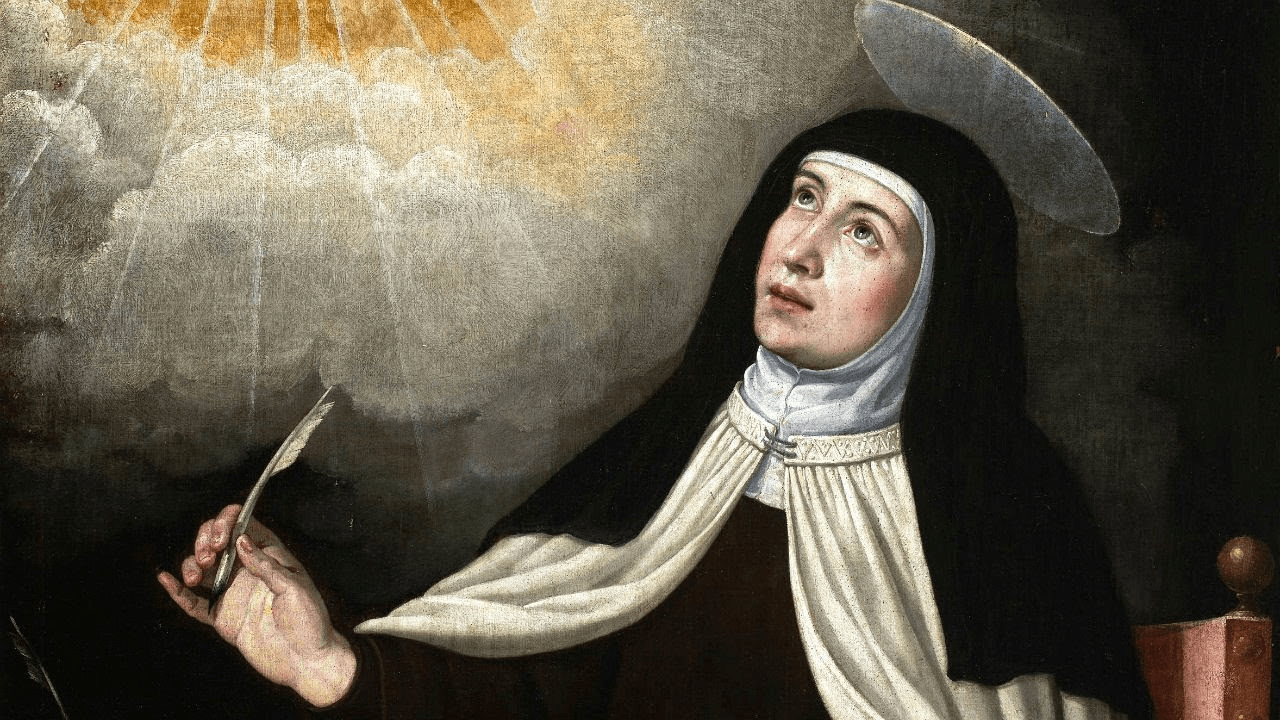
This day, St. Teresa of Avila founded the Carmelite nuns.
Active during the Counter-Reformation, Teresa emerged as the pivotal figure in a movement aimed at spiritual and monastic renewal, reforming the Carmelite Orders for both women and men. This movement was later joined by the younger Carmelite friar and mystic, Saint John of the Cross, with whom she founded the Discalced Carmelites. A formal papal decree recognizing the separation from the old order was issued in 1580.
Her autobiography, The Life of Teresa of Jesus, along with her works The Interior Castle and The Way of Perfection, are significant contributions to Christian mysticism and meditation practices. In her autobiography, which serves as a defense of her ecstatic mystical experiences, she identifies four stages in the soul’s ascent to God: mental prayer and meditation; the prayer of quiet; absorption-in-God; and ecstatic consciousness. The Interior Castle, crafted as a spiritual guide for her Carmelite sisters, employs the metaphor of seven mansions within the soul’s castle to illustrate the various states one’s soul may experience throughout life.
Forty years following her death, in 1622, Teresa was canonized by Pope Gregory XV. On 27 September 1970, Pope Paul VI declared Teresa the first female Doctor of the Church, honoring her enduring spiritual legacy to Catholicism.
“Truth suffers but never dies.”-— St. Teresa of Avila
ALSO ON THIS DAY
410 – Rome was invaded and conquered by Alaric and his Visigoth army. Known as the Sack of Rome, it is seen as a major landmark in the fall of the Western Roman Empire. St. Jerome, living in Bethlehem, wrote: “the city which had taken the whole world was itself taken”.[7]
1662 – In their refusal to assent to the Book of Common Prayer. Two thousand Puritans had to vacate their pulpits, becoming known as non-conformists.
1741 – After much misery because of his spiritually lost state, Isaac Backus experiences personal salvation in Christ at the age of eighteen while plowing alone in his fields. In his diary, he records, “I was enabled by divine light to see the perfect righteousness of Christ and the freeness and richness of His grace with such clearness that my soul was drawn forth to trust in Him for salvation. The Word of God and the promises of His grace appeared firmer than a rock, and I was astonished at my previous unbelief.” He will go on to become a Baptist pastor and successful evangelist in New England.
1795 – Death of Samuel Stennett. One of the outstanding dissenter (non-Anglican) preachers of his day, he had been a personal friend of England’s King George III. He wrote the hymns “Majestic Sweetness Sits Enthroned” and “On Jordan’s Stormy Banks I Stand.”
 Rhemalogy