
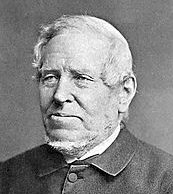
While boarding a train on November 16, 1895, Samuel Francis Smith was bound for Boston for a preaching assignment. Suddenly, he gasped, raised his hands, and collapsed, dying instantly. Obituaries were published in newspapers throughout the United States, as the Baptist preacher was well-respected for writing one of America’s most famous patriotic songs: “America.” Its final stanza was arguably the best:
Our fathers’ God, to Thee, Author of liberty,
To Thee we sing.
Long may our land be bright
With freedom’s holy light;
Protect us by thy might,
Great God, our king.
In 1808, he was born in Boston, Massachusetts. In later years, he attended a Latin school, then Harvard, and finally Andover before becoming a Baptist pastor. He had a deep passion for languages, mastering fifteen throughout his life. From 1834 to 1841, he served as both the pastor of the First Baptist Church in Waterville and a professor of languages at its college.
His expertise in languages inspired him to create his well-known hymn. In 1831, hymn writer Lowell Mason received copies of some German hymns and music. Unable to understand the words, he asked Smith to review them and translate any worthwhile ones, or to compose new lyrics for the German melodies.
While reviewing them “on a dismal day” the following February, Smith found a tune that seemed easy for children to sing. The German lyrics were patriotic. “I was instantly inspired to write a patriotic hymn of my own,” he later recalled.
Smith had been writing poetry since he was eight years old, and it took him only about thirty minutes to compose the famous lines. Unbeknownst to him at the time, the melody was the same one to which the British sing “God Save the Queen.” He faced criticism for this, but Lowell Mason was evidently unfazed. He surprised Smith by playing “America” on that Fourth of July.
Smith served as editor for The Christian Review and various Baptist missionary publications, as well as hymn and psalm books. He also edited a history of Newton, Massachusetts, where he was a pastor for many years and where he resided at the time of his death. He later wrote a life of Joseph Grafton, one of his predecessors in the Newton church. Twice, he toured mission fields on behalf of his denomination.
Seven months before his sudden death in April 1895, a testimonial committee honored him with a fundraiser for his hymn.
Also On This Day
1845 – Hymnwriter Frederick Faber announces he is migrating to the church of Rome.
1885 – Despite the martyrdom of his mentor, Joseph Mukasa, the day before, Denis Ssebuggwawo came secretly to Catholic missionaries in Uganda and was baptized by Père Simon Lourdel, M.Afr., also known as Fr. Mapera, and he took the name Denis as his Christian name. Six months later, King Mwanga will have him executed because of his faith.
1894 – Death of James McCosh, eleventh president of Princeton. Born in Scotland, he had helped establish the Scottish Free Church and become a philosopher and theologian of note in the Presbyterian tradition.
1946 – The United Brethren in Christ and the Evangelical Church unite to form The Evangelical United Brethren Church at Johnstown. The groups originated from the labors of United Brethren in Christ evangelists Philip W. Otterbein and Martin Boehm, and also from the evangelism of Jacob Albright (Evangelical Church).
 Rhemalogy