
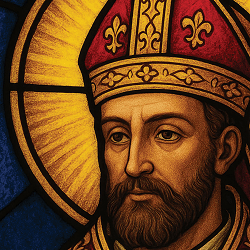
Cyprian of Carthage was born into privilege around the year 200. He excelled in rhetoric, mastering persuasive speaking and establishing a school. He taught public speaking by debating philosophers and Christians.
Around age forty-five, a Christian elder’s words moved Cyprian to convert. He felt reborn by the Spirit. He gave up his wealth, embraced celibacy, and dedicated himself to scripture. He was baptized at Easter in 246.
Two years later, the bishop of Carthage died. The people chose Cyprian, despite his objections. He quickly became a prominent leader in North Africa. He was seen as dignified, joyful, and respected. Yet, his path would be challenging.
Some clergy envied his new position. Others disliked his firm discipline. Two years after becoming bishop, pagans called for his death. Cyprian fled into hiding. He led his flock through letters. Those who remained and faced torture felt abandoned. The Decian persecution ended in 251. Cyprian returned, but new trials awaited.

Christians who had denied their faith or bought certificates of compliance were known as “lapsed.” Some believers felt the lapsed should not rejoin the church. They formed their own group and performed baptisms. When some of their followers sought to rejoin the main church, Cyprian insisted that they be rebaptized by recognized priests. Pope Stephen, bishop of Rome, disagreed. He believed baptism was valid if done in the name of the Trinity.
Cyprian argued that sacraments outside the church lacked power. He believed there was only one true church. Therefore, splinter groups could not possess the Holy Spirit. He wrote On the Unity of the Church to explain his views. Councils in Carthage supported him. However, Stephen threatened excommunication. Cyprian eventually relented, agreeing that rebaptism was not necessary.
A terrible plague swept through Carthage from 252 to 254. While pagans deserted the sick, Cyprian guided Christians in caring for the dying. They did this even as they were blamed for the outbreak.
Soon, persecution reignited in North Africa. The governor banished Cyprian to a coastal town. After the governor’s death, Cyprian returned to Carthage. The new governor then sentenced him to death. On September 14, 258, Cyprian declared his Christian faith and refusal to worship pagan gods. He thanked God for freedom from his earthly body. He gave the executioner gold, knelt in prayer, and covered his own eyes before his execution. His brave death deeply moved the witnesses.
ALSO ON THIS DAY
407 – Death of John Chrysostom (“golden mouth”), considered the greatest preacher of his era. He was being forced to march into remote exile despite severe illness.
1224 – Francis of Assisi has a vision of a Seraph. Filled with joy, he discovers wounds have appeared on his hands, feet, and side (the stigmata).
1321 – Death of Dante Alighieri, author of the greatest epic of medieval Christianity, The Divine Comedy.
1814 – Francis Scott Key, an Episcopalian layman and cofounder of the American Sunday School Union, is inspired to write the song that becomes America’s national anthem, “The Star-Spangled Banner,” when he sees that Fort McHenry has not struck its colors after a night of heavy bombardment by British ships during the War of 1812.
1975 – Mother Elizabeth Ann Bayley Seton is canonized by Pope Paul VI, becoming the first person born in the United States to be declared a saint of the Catholic Church.
1996 – Funeral of Mrs. Joannah Mobola Ayorinde, at First Baptist Church, Broad Street, Lagos, Nigeria. She had been a holy and fearless Baptist leader of the Women’s Missionary Union.
 Rhemalogy