
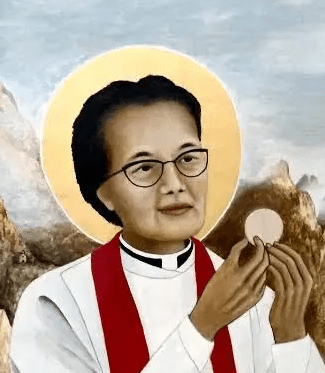
On 25 January 1944, a small Anglican church in Zhaoqing, China, was crowded with worshipers from several Christian communities, including a holiness church and an institute for the blind. During the service, the candidate for the priesthood was asked the traditional questions of ordination and responded as expected. Bishop Robert Hall and his assistant, Lai Kei Chong, laid hands on her and pronounced the ancient words authorizing her to preach and administer the sacraments. With this act, Florence Li Tim-Oi became a priest—the first woman ordained in the Anglican Church.
Li was the daughter of a concubine. Though her father was Christian, he practiced polygamy, yet he delighted in his daughter and named her “Much Beloved Daughter.” From childhood, Li valued both faith and education. Although her brothers were sent to college, she remained at home until age twenty-four, when she persuaded her father to let her attend theological seminary. After graduating, she became a deaconess in Hong Kong, taking the name Florence in honor of Florence Nightingale, and quickly proved indispensable in ministry.
After Japan invaded China in 1937, Li was transferred to Macau, which had become a refuge for those fleeing the war. As conditions worsened, priests could no longer safely travel there to administer the sacraments. Bishop Hall authorized Li to consecrate and distribute communion. Eventually, he concluded that since she was performing a priest’s work, she should be ordained. He summoned her to Zhaoqing, a journey that required crossing mountains, evading Japanese patrols, and relying on locals for protection. When she arrived safely, Li knelt in prayer in gratitude.
By the time of her ordination, Li had already endured hunger, danger, and threats for her faith, including a perilous mission to rescue her father from occupying forces. After the war, her suffering continued under the communist regime. Forced into the state-controlled Three Self Patriotic Movement, she was publicly denounced, compelled to write self-criticisms, and sent to hard labor. Her Bible was destroyed, and despair once drove her to consider suicide, but she resisted, believing it would dishonor Christ.
After the Great Leap Forward and Cultural Revolution, Li was assigned to teach children. Eventually allowed to retire, she received a small pension and later emigrated to Canada, then traveled to England, where her historic ordination was formally recognized. Though criticized for his decision, Bishop Hall never recanted, insisting the Holy Spirit—not human custom—had called Florence Li Tim-Oi to the priesthood.
Also On This Day
4 BC – 64 AD – The Feast of the Conversion of St. Paul, marking the dramatic transformation of Saul the persecutor into Paul the Apostle on the Road to Damascus.
1627 – Birth of Robert Boyle, renowned physicist and chemist, born in Ireland, who wrote extensively on science and religion and funded defenses of Christianity
1841 – Anglican John Henry Newman published the controversial Tract 90, attempting to show that the Thirty-nine Articles of the Church of England could be interpreted in a Catholic sense.
1908 – Birth of Anne Blake Wooding, a pioneer missionary to the blind in Kano, Nigeria.
1918 – Commemoration of New Martyrs (Orthodox): Metropolitan Vladimir of Kiev was murdered, leading the Orthodox Church to commemorate all Russian martyrs and confessors killed by the Soviets on or around this day.
 Rhemalogy